

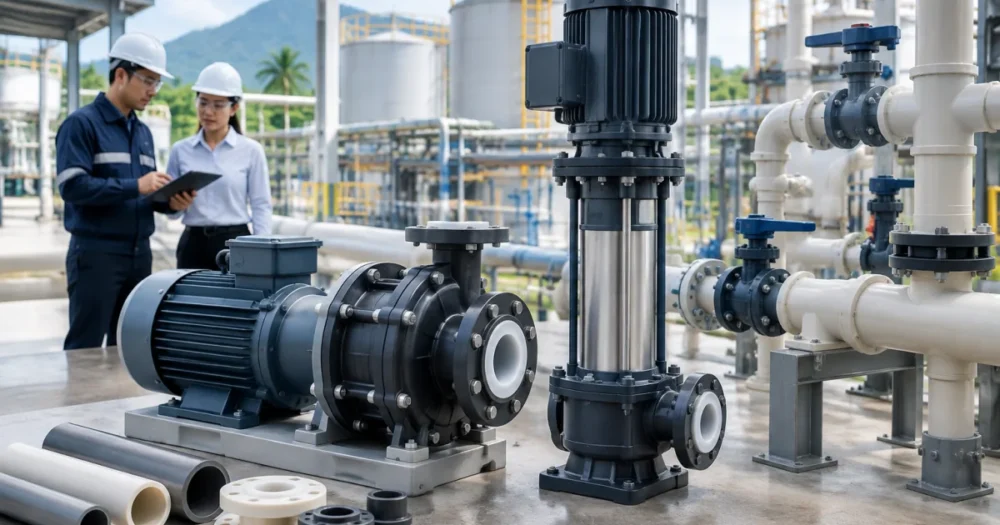
Overview
When procurement, engineering, and EHS all touch the same pump purchase, the “best” option is rarely the one with the highest nameplate numbers. In Malaysia’s wet-process and treatment environments, a pump is a containment device as much as it is a flow device. That reality is why the supplier you choose matters: not only for product fit, but for documentation readiness, chemical compatibility discipline, and the ability to support you when operations change.
This guide breaks down the 2026 procurement signals buyers should watch when evaluating a chemical pump supplier Malaysia—especially for corrosive chemical transfer, scrubber circulation, electroplating lines, wastewater transfer, and water treatment skids. The focus is practical: what to ask for, what to verify, and what red flags typically show up late (when they are most expensive).
Signal 1: “Compliance-ready” isn’t a claim—it’s a document pack
Many pump RFQs include a line like “provide compliance documentation,” but buyers often don’t define what “complete” looks like. In 2026, a strong supplier signal is the ability to deliver a clean, consistent documentation set quickly—because missing documents can stall FAT/SAT approvals, vendor registration, or site permitting workflows.
What a buyer should request early
- Material declarations for wetted parts (not just the pump casing). Ask for a clear list of wetted components: casing, impeller, shaft sleeve, thrust washers, O-rings, and any liner materials.
- General arrangement / dimensional drawings with connection standards and orientation options (important for retrofits and skid layouts).
- Performance curve and operating limits (duty point range, max temperature guidance, and any derate notes for viscosity or specific gravity).
- Installation and O&M guidance specific to chemical service (priming, venting, flushing, dry-run limitations).
- Test and inspection evidence when applicable (for example, in-house test reports or a documented testing process). The key is consistency and traceability, not flashy templates.
Practical tip: Ask the supplier to show you a redacted sample document pack from a similar application. The goal is to validate maturity: a supplier that can produce structured documents on day one usually also manages configuration control better (reducing the risk of “quiet substitutions” at delivery).
Signal 2: Material compatibility is becoming the main selection battle
For chemical pumps, procurement risk often comes from the wrong materials, not the wrong flow rate. What’s changing in 2026 is that more buyers are standardising material families and requiring suppliers to justify compatibility in a transparent, auditable way—especially for mixed chemical inventories and cleaning cycles.
What to evaluate beyond “PP vs PVDF”
- Wetted path clarity: PVDF or GFRPP in the casing is not the full story if the impeller, bushings, or elastomers are different.
- Elastomer selection discipline: O-ring compatibility issues can present as mysterious leaks, air ingress, or loss of prime. Confirm the elastomer options available and how the supplier selects them for acids/alkalis/oxidizers.
- Chemical concentration and temperature realism: A supplier that asks for concentration range and operating temperature (not just “HCl” or “NaOH”) is usually protecting you from premature failures.
- Process upset tolerance: Ask how the pump behaves if concentration spikes, temperature rises, or the line sees intermittent solids—common in wastewater and scrubber sumps.
ASIA PUMP (M) SDN BHD supplies corrosion-resistant material options such as GFRPP and PVDF for aggressive chemical duties, and can support buyers with pump selection & sizing to align real operating conditions (SG, viscosity, temperature, line losses) to the correct pump construction.
Signal 3: Sealless and vertical designs are being shortlisted earlier
Buyers are increasingly narrowing the shortlist by pump architecture before they compare brands. Two categories often move forward early because they reduce specific operational risks: sealless magnetic drive pumps and vertical chemical pumps.
When a magnetic drive chemical pump is the procurement-friendly choice
A magnetic pump (sealless magnetic drive) can be a strong fit when leakage control, product purity, and reduced seal maintenance matter. The procurement signal to watch is whether the supplier can explain the limitations just as clearly as the advantages—especially around dry-run sensitivity, heat generation, and the need for correct NPSH and venting practices.
- Look for: clear guidance on start-up procedures, minimum flow requirements (if any), and recommended protection (run-dry sensors, pressure/flow monitoring) for critical services.
- Red flag: “Sealless means maintenance-free.” Sealless reduces one failure mode (mechanical seal leakage) but introduces other considerations (bushing wear, heat management, system cleanliness).
Why vertical chemical pumps keep appearing in wet-process lines
For tanks, sumps, pickling baths, scrubber basins, and plating lines, a vertical chemical pump can reduce footprint and simplify suction conditions because the hydraulics are positioned in the tank. In procurement, the key signal is the supplier’s ability to specify immersion length, column material, bearing/bushing arrangement, and maintenance access.
If you’re comparing options, you may find it useful to review application-focused guidance such as vertical chemical pump Malaysia reliable solutions for industrial applications to align design choices with your tank geometry and duty cycle.
Signal 4: Lead-time confidence is now a technical evaluation, not a promise
“Lead time: 4–6 weeks” is not a plan. In 2026 procurement, buyers increasingly score suppliers on lead-time confidence: their ability to deliver the right configuration, with the right materials, with minimal rework—plus the ability to support a fast replacement if a pump fails unexpectedly.
How to validate lead-time readiness
- Configuration control: Can the supplier lock a configuration against your RFQ (materials, motor specs, flange standards, elastomers, accessories) and reflect it consistently on quotes, order acknowledgements, and delivery notes?
- Inventory strategy: Do they keep common models/parts locally or regionally? For critical plants, parts availability can matter more than initial purchase price.
- Factory / in-house testing capability: A supplier with a defined repair and testing workflow can shorten downtime and give you more confidence in replacements and overhauls.
- Spare parts list at ordering: Ask for a recommended spares list tied to your duty and expected maintenance interval (bushings, O-rings, impeller, thrust components, etc.).
For Malaysian industrial operators, lead-time planning is also about selecting the right pump type for the duty. For example, a self priming chemical pump can reduce commissioning delays in applications where suction lift and intermittent air ingestion are common (transfer from IBCs, sump evacuation, unloading, certain wastewater duties)—but only if the supplier specifies priming limits, compatible materials, and the correct piping layout.
Signal 5: Supplier capability is shifting from “sell a pump” to “support the system”
Procurement teams increasingly prefer a supplier who can operate as a technical partner—especially when a system integrator is building a skid or when an end user expects lifecycle support. This doesn’t require a massive engineering firm; it requires disciplined application questioning and after-sales follow-through.
Questions that reveal real application competence
- Do they ask for your duty point and system curve inputs? A reliable pump selection & sizing conversation includes static head, friction losses, suction conditions, fluid properties (SG/viscosity), and operating temperature.
- Do they challenge your assumptions politely? For example, pointing out when a requested flow/head combination will cause operation far from BEP, or when a vertical design may be easier to maintain than a flooded horizontal installation.
- Do they offer filtration/ancillary options where needed? In plating and PCB wet lines, pairing pumping with chemical filtration systems can stabilise process quality and protect pump internals from particulate wear.
To deepen your supplier evaluation beyond the pump itself, a useful cross-check is how the supplier approaches filtration selection. See 5 things to consider when choosing a chemical filter supplier in Malaysia and compare it against your internal quality and bath-management requirements.
A buyer’s checklist for shortlisting and de-risking your RFQ
Use the checklist below to standardise vendor comparisons. It is designed for procurement managers and plant engineers who need to defend the decision to operations, EHS, and finance.
| Evaluation area | What to ask for | What “good” looks like |
|---|---|---|
| Material compatibility | Wetted-part list, material grades, elastomer options | Clear bill of wetted materials; questions about concentration/temp; PVDF/GFRPP choices justified |
| Compliance readiness | Sample document pack, drawings, O&M, test workflow | Fast turnaround; consistent revision control; application-specific guidance |
| Pump architecture fit | Why magnetic drive vs sealed; why vertical vs horizontal | Pros/cons explained; limits stated; protection recommendations provided |
| Lead-time confidence | Configuration lock, spares list, inventory approach | Order documentation matches quote; spares offered; realistic delivery plan |
| After-sales support | Repair/testing capability, troubleshooting process | Defined support workflow; ability to test/verify performance; responsive technical guidance |
Conclusion: In 2026, the strongest procurement signal is risk transparency
When you’re choosing a chemical pump supplier, the differentiator is rarely a single headline feature. In 2026, the most reliable vendors tend to be the ones that make risk visible and manageable: they document clearly, confirm material compatibility down to the wetted parts and elastomers, recommend the right architecture (vertical, self-priming, or sealless magnetic drive) for the real operating scenario, and demonstrate lead-time confidence with configuration control and parts readiness.
If your team is shortlisting for scrubbers, electroplating lines, chemical manufacturing transfer, wastewater treatment, or PCB wet-process applications, treat the RFQ like a system-risk exercise. The result is fewer commissioning surprises, fewer unplanned change orders, and a pump installation that performs consistently in day-to-day plant reality.
For additional background on why build quality and application fit matter in Malaysian industrial environments, see why chemical pump quality matters in Malaysias chemical and manufacturing industries.
Frequently Asked Questions
What should I ask a chemical pump supplier in Malaysia to confirm material compatibility?
Ask for a full wetted-part material list (casing, impeller, bushings/sleeves, and O-rings), plus confirmation of your chemical concentration range and operating temperature. A good supplier will also ask about specific gravity, viscosity, and any cleaning/flush chemicals to avoid hidden incompatibilities.
When is a self-priming chemical pump a better choice than a standard centrifugal pump?
A self-priming chemical pump is often preferred when suction lift is present, the suction line can ingest air, or the source tank level varies—common in unloading, sump evacuation, and some wastewater duties. Confirm priming limits, compatible materials, and recommended piping layout (especially suction line design) with the supplier before ordering.
Are magnetic drive (sealless) chemical pumps always safer?
Sealless magnetic drive pumps reduce the risk of leakage from mechanical seals, which can be valuable for corrosive or hazardous fluids. However, they still require correct system design and operating discipline (for example, avoiding dry run and managing heat). Safety improves when the supplier provides clear operating limits and appropriate protection recommendations.
What are key specification points for a vertical chemical pump in tank applications?
Verify immersion length, column and wetted materials, bushing/bearing arrangement, discharge orientation, and how maintenance will be performed (lift-out space, access to the wet end). Also confirm whether the liquid contains solids or crystals that could accelerate wear.
How can I evaluate lead-time reliability before placing a purchase order?
Request a configuration-locked quotation (materials, elastomers, connection standards, motor details, accessories), a recommended spare parts list, and an outline of the supplier’s inventory and testing/repair capability. Consistent documentation and clear configuration control are strong indicators of dependable delivery and smoother commissioning.
Shortlist with confidence with ASIA PUMP (M) SDN BHD
If you’re evaluating a chemical pump supplier for corrosive transfer, scrubbers, plating/PCB wet lines, or wastewater duties, ASIA PUMP (M) SDN BHD can support you with pump selection & sizing, corrosion-resistant options (including PVDF and GFRPP), sealless magnetic drive pumps, vertical chemical pumps, self-priming chemical pumps, and ongoing after-sales technical support. Share your duty point, chemical details, and installation constraints—our team will help you match the right pump design and materials to reduce compliance, compatibility, and lead-time risks.
Disclaimer:
We hope you find this article helpful and informative. Our content is intended for general informational purposes only and does not constitute advice or necessarily reflect the full range of services offered by Asia Pump (M) Sdn. Bhd.
For personalized advice, please consult with a professional or contact us directly. While we strive for accuracy and completeness in our blog posts, we cannot guarantee they are error-free. Asia Pump (M) Sdn. Bhd. assumes no responsibility for any errors or omissions.